for high quality jpgs of images on these pages or to commission original images email me at swordwhale@yahoo.com

connecting kids (and others) with the natural world
I've wrangled barfing vultures, baby tigers, otters (they bite!), and participated in the Great Emu Roundup (yee-hah!..and it's hard to rope one, they're shaped to shed lariats) volunteering with local wildlife rehabbers. I've also had the honor of volunteering with a local county park/nature center whose mission is to educate people about the environment. I've also had the honor of them allowing me to smear paint over their walls (they actually pay me for this). Here are a few examples of murals (portable, permanent and transitory), cartoons and other illustrations that hopefully give kids an insight onto dirt, bears, oceans, forests and other wonders of Planet Water.
Wetlands
My favorite place is wetlands, and my favorite medium is watercolor. Here are some illustrations I did for a watershed alliance and others.Most are from my own photos except for a few photos from PA Birders (facebook), whose photographers let me do art from their pics. A few like beaver and muskrat had to be researched online.
Nixon Park Gift Shop Illustrations
A few designs for buttons and cards, most are based on animals found at the park,
whether live outside, or the park's world class taxidermy.
whether live outside, or the park's world class taxidermy.
"The Salamander Room"
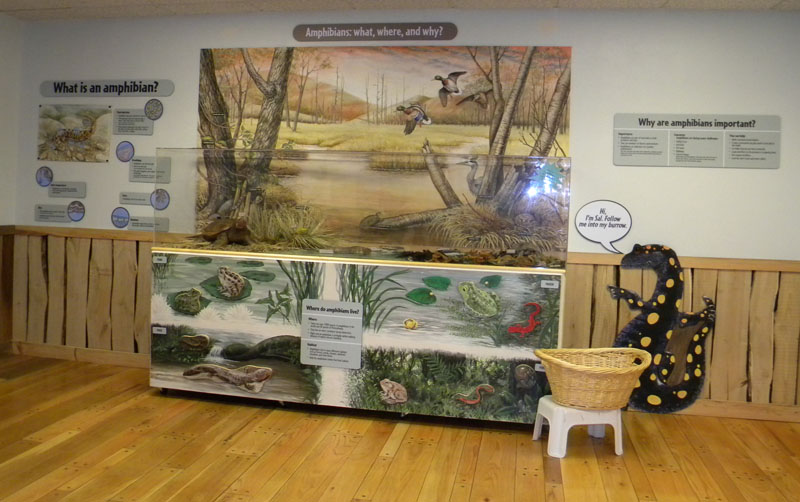
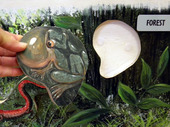
...was the name of an excellent kids' picture book, about a boy who wants a salamander, and begins to bring in all the habitat the salamander needs to survive...ending with his room being the forest itself. Nixon Park's "Bee Room" (where the hive can be observed) contains a display on local amphibians and reptiles. I did the standee "Sal" pointing to the crawl-through salamander tunnel (with small cartoons explaining the world of salamanders), the hellbender "parts of an amphibian" poster to the left, and the four habitats with cutouts to place (like a puzzle) of amphibians to place in their habitats.
for more, click here
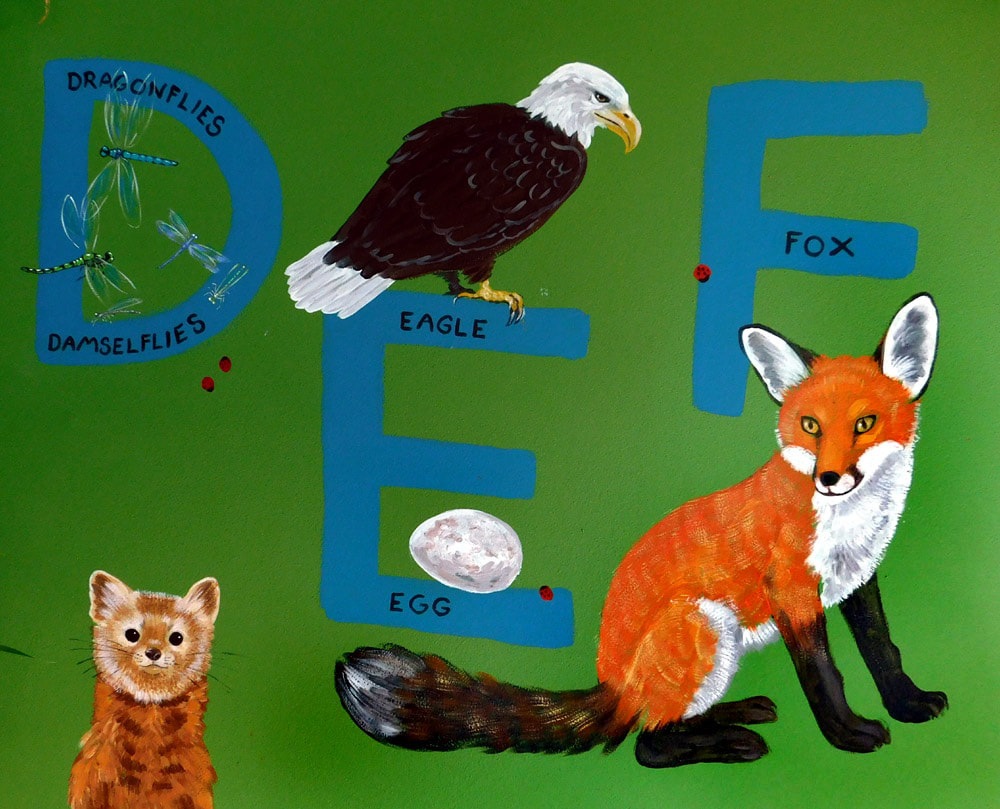
animal alphabet and counting one to ten
For the Boetcher House's nature based daycare in Lancaster PA.
Landis Woods, Part of Manheim Township Parks.
more here: (click)
Landis Woods, Part of Manheim Township Parks.
more here: (click)
Touch Rooms: Nixon County Park, York County PA
As part of its educational mission, Nixon Park's visitor's center has a "touch room" full of hands-on activities for young kids and their parents. Murals, games, "design-your-own" forest (or ocean or bird...) wall, dress-up chest, puppet theater.
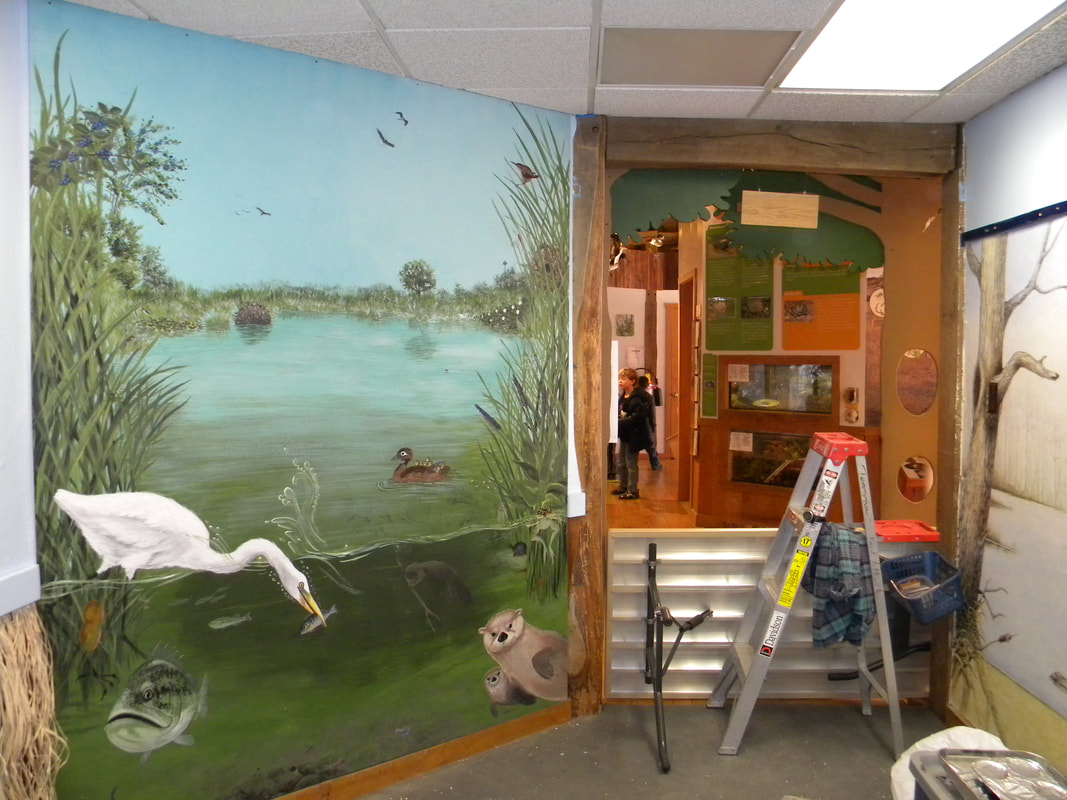
Touch Room Wetland
Nixon Park's touch room becomes an important environment not many appreciate. This time, instead of painting on the walls directly, I painted on large boards (they'd only fit in my basement!). Most of the critters were from my own photos, often shot over the bow of my kayak.
more: click here...
more: click here...
Touch Room Ocean
For "Under the Sea", I did a wall mural (how do you fit a life-sized blue whale into a twenty foot room? Perspective), and cartoons of sea animals illustrating fact sheets. A cousin contributed a surfboard (the same size as the dorsal fin of a male orca, "swordwhale".
more: click here...
more: click here...
Touch Room Forest
This is a scene in a white oak forest with a dozen of its denizens. The brown tags cover part of the critter and have clues to the animal's identity. Lifting them reveals the whole critter and the answer. First I did a watercolor sketch in my sketchbook. Armed with photos and illustrations of the critters, I tackled the wall. Chalk often works well to sketch, but this wall has a rough texture: paint on a pointy brush worked better. In the fox sketch, you can see the blue paint I started with: a very rough sketch. That was refined with black.
more: click here...
more: click here...
Watershed Mural
The purpose of the Nixon Park visitor's center is education, connecting people with the natural world they are part of. 3D displays on the North Woods, the Arctic, Africa and others incorporate taxidermy, habitat and murals. The wall by the restrooms became a focal point for educating people about the watershed they live in: the east branch of the Codorus Creek (which the park is also part of). A water meter measuring park use sits to one side. I started by looking at maps and aerial photography of the area, but interpreted the spaghetti maze of visual information, simplifying it into a landscape hopefully everyone can relate to. I used Photoshop to compose a rough, then projected the map on the wall, traced, then painted with house paints. House paint is opaque and you have to be careful how you mix it or you get a muddy chalky mess. Choosing the right colors to start with was important.
Soil, It's Not Just Dirt
Naturalist Jodi was sitting on the floor surrounded by a pile of paper, printed with an encyclopedic volume of information about dirt.
"What are you doing?" I asked.
"A display about dirt."
"Sounds exciting."
Yeah. How can we get people to look at this and absorb information about that stuff under their feet. Ah, cute cartoon characters. Someone else had done something with an earthworm. Worms are hard to cartoon, to anthropomorphize. Perhaps because they don't have hands..or arms or legs or any other recognizeable body parts. We thought about what lives in soil and came up with salamanders. They're kind of cute; they have big eyes and bright colors, "hands" and can be anthropomorphized. Voile soiley!
"What are you doing?" I asked.
"A display about dirt."
"Sounds exciting."
Yeah. How can we get people to look at this and absorb information about that stuff under their feet. Ah, cute cartoon characters. Someone else had done something with an earthworm. Worms are hard to cartoon, to anthropomorphize. Perhaps because they don't have hands..or arms or legs or any other recognizeable body parts. We thought about what lives in soil and came up with salamanders. They're kind of cute; they have big eyes and bright colors, "hands" and can be anthropomorphized. Voile soiley!
Raptor Red
Raptor Red is the title of an excellent book by paleontologist Robert Bakker, a fun lecturer who punctuates his talks with giant marker drawings of dinos which he gives away to kids (and appreciative adults) who answer his dino questions correctly. RR is a Utahraptor, discovered while Steven Spielburg was doing his first Jurassic Park film. He had enlarged velociraptor (about the size of a large dog) for movie impact. Then they found Utahraptor. I did this portable mural for Nixon Park's Dinosaur Weekend. I drew her on plywood (an enterprising maintenance guy cut her out), and painted her with house paints from our tool room, using house brushes, artist brushes, rollers and sponges. More recent paleontology suggests they, and many other dinos, had feathers.
Chipmunks
"You will know more about chipmunks than you ever imagined." The park director said something like that as he handed me a pile of books about this small striped ground squirrel. I absorbed facts about chipmunks and their burrows, doodled in my sketchbook, ran it past the naturalists and park director and went to work on eleven feet of brown craft paper with crayons, pastels and Prismacolor pencil. It was laminated, and serves as a portable mural about the hidden lives of chipmunks.
Wild Things
Wildlife rehabbers care for orphaned and injured wildlife; native animals are protected by game laws, you need a permit (and a lot of training and experience) to care for even orphaned bunnies (highly sensitive and prone to dying suddenly). I was one of many volunteers who helped Mitzi Eaton (raptors) and Barb Gregory (mammals, waterfowl, and the odd exotic) care for wild things. I also trained a few wild mustangs, including my own black mare who had run wild for the first 8 years of her life before coming to me.
I learned a few things: vultures barf when upset (stinky! and it distracts predators from eating the vulture), a three pound great horned owl can handcuff you quite effectively to a perch (one foot on your glove, one on the perch...there you stay), owls have 1000psi per talon tip... and they have eight talons, otters can bite through 6 mil dive gloves, a four month old tiger can encompass my ample thigh with its jaws, don't lasso an emu, the rope just slides off their aerodynamic shape, owls and hawks in the buteo family (redtail, broadwing) will tolerate a classful of screaming third graders but accipiters (sharp-shinned, Coopers) and falcons will dive off your glove and hang there like the Great American Batbird. They make awesome falconry birds for the expert.
Here are a few illustrations I did as T-shirt designs, coloring book pages, and one illustration of my own mustang adpted through the BLM's Adopt-a-Horse (wild horses) program. (This appeared in a book of Nancy Springer (Connor)'s poetry: Stardark Songs).
I learned a few things: vultures barf when upset (stinky! and it distracts predators from eating the vulture), a three pound great horned owl can handcuff you quite effectively to a perch (one foot on your glove, one on the perch...there you stay), owls have 1000psi per talon tip... and they have eight talons, otters can bite through 6 mil dive gloves, a four month old tiger can encompass my ample thigh with its jaws, don't lasso an emu, the rope just slides off their aerodynamic shape, owls and hawks in the buteo family (redtail, broadwing) will tolerate a classful of screaming third graders but accipiters (sharp-shinned, Coopers) and falcons will dive off your glove and hang there like the Great American Batbird. They make awesome falconry birds for the expert.
Here are a few illustrations I did as T-shirt designs, coloring book pages, and one illustration of my own mustang adpted through the BLM's Adopt-a-Horse (wild horses) program. (This appeared in a book of Nancy Springer (Connor)'s poetry: Stardark Songs).
